
ADVENTURE
AIDS
AIRLINES
AIRPORT
AIRPORT BUS
ARCHAEOLOGY
ARCHITECTURE
ARCHIVES
ART GALLERIES
BANKS
BIRDING
BOOK EXCHANGE
BUDGET TRAVEL
BUSES
BUSHFIRE
BUSHMAN PAINTINGS
BUSHMEN
CAMPSITES
CAR HIRE
CARS and DRIVING
CATTLE
CLIMATE
COLONIALISM
CRIME
DRUGS
ECONOMY
HISTORY
IMMIGRATION
KINGS
MBABANE
NATURE RESERVES
POLICE
RITUAL CEREMONIES
SIBEBE TRAILS
TOUR COMPANIES
TRAVEL AGENCIES
Index to information in the guide
Swaziland may not have been visited by Arabs, but it was certainly inhabited by early man: humans and proto-humans (australopithecines) have lived in Swaziland for as long as our species has been on the planet. Evidence, in the form of an early skull, stone-age tools and the remnants of the oldest known mine in the world point to the continued presence of man since early times.
We know from extensive stone tool finds throughout East Africa that this was a widespread cultural and evolutionary phase. The only place on earth where an early, yet totally modern, skull has been found is at Border Cave (sited about 100 meters into the Ingwavuma district of KwaZulu-Natal, South Africa ) but this is not to say that Border Cave man evolved only in Swaziland/South Africa at all.
There is some debate about the period during which Border Man would have inhabited the region but one estimate has dated the skull at around 100,000 years old, modern humans are believed to have evolved between 160 to 200 000 years ago. It is possible that the Khoi-San (or Bushmen) groups are descended from Border Cave man and have had a continuous sequence from then until lately in this area.
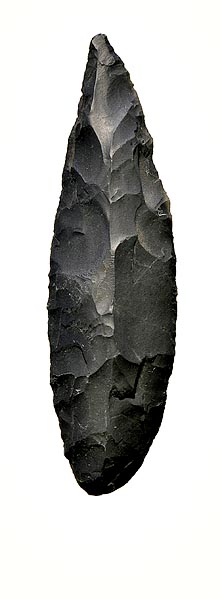
Generally archaeology has been split up into three broad phases. The first of these was the early stone age, when tools were first made by our pre-human ancestors. Although no fossils of the bones of these australopithecines have been found here (Swaziland has no limestone deposits to aid fossil formation), tools of these early inhabitants - Early Stone Age hand axes - have been found in large numbers, so we know that they were here.
 |
During the Middle Stone Age, around 200,000 to 35,000 years ago, stone spears and arrow points were also made by these early people. At this time too, they had begun to use fire for heat and possibly cooking which means that the hunters had moved into caves and shelters. These early inhabitants also knew about mining and Swaziland boasts the oldest known mine in the world. 40,000 to 45,000 years ago, people were mining ochre and specularite, a reflective form of iron, from the hills around Ngwenya, near Oshoek bordergate. The specularite and ochre were used for symbolic or ritual purposes, since the smelting process used in making metal tools was undiscovered at that time. (See Nature Reserves, Malolotja, for details on how to reach the mine.) The Late Stone Age people used finely made quartz tools (some very tiny) in a similar manner to that of the Bushmen in the Kalahari. The Late Stone Age continued with the Bushmen until the nineteenth century when the Bushmen were culturally eradicated in Swaziland. Although there are no Bushmen leading a totally nomadic traditional way of life any more, their genetic heritage continues in the peoples of southern Africa. About 1,500 years ago, peoples from East and Central Africa moved down the Rift Valley, bringing with them the new technology of iron smelting and the domestication of crops such as sorghum as well as sheep and goats. Little is known of this first wave, they have been given the arbitrary name "Silverleaves" by archaeologists. Nobody knows where they came from, what language they spoke or what happened to them. Later Bantu speaking peoples came bringing cattle with them. They settled in this area and colonised much of southern Africa, introducing their crops throughout, except for the Cape area where the winter rainfall was unsuitable for the growing sorghum, their staple crop. In the broadest terms there are two major language groups in the region, Sotho and Nguni. The Sotho people tended to settle the high flat lands of the interior and the Nguni occupied the coastal plains and low lying areas inland. It is from the Nguni that the Swazi nation is descended. |